Speaking of saying goodbye, I was very sad to see Sounds of RVA’s farewell message. I’ve enjoyed following along with Sarah’s posts and have learned a lot from them. Between this announcement and RVA Playlist’s, it feels like the end of an era. Sarah and Andrew have felt like partners in crime, and I’ll always appreciate the added motivation I’ve gotten from knowing there are people our there with whom I share a sense of purpose. Definitely going to deploy my prized Sounds of RVA coozie tonight in Sarah’s honor.
Important PSA: Don’t forget to check that the albums you find at Goodwill actually have the right records inside. I thought I’d found a nice, clean copy of Pearls Before Swine’s Balaklava. I had actually found the cover of Pearls Before Swine’s Balaklava with some crusty big band nonsense inside.
It’s hard to overstate the influence the people in this photo have had on my musical life.
Not long after Phil Cook started playing at last week’s Friday Cheers, I saw Matthew E. White walk through the crowd and settle in near the front, and at the risk of being a little bit of a creeper, I made sure to get a shot of these two hugely important people in one place.
This was my first time seeing Phil Cook play under his own name, but I’ve gotten to see him perform three (I think) times before — twice with Hiss Golden Messenger in Richmond and once with Megafaun in Portland, OR. That 2011 Portland show at the Doug Fir was the seed of something that’s grown much bigger. I’ve written about this idea before, but every single thing the Megafaun diaspora touches or is associated with — HGM, Sylvan Esso, The Shouting Matches, Grandma Sparrow — turns to gold, and those projects and Phil Cook’s solo album have brought me a great deal of happiness in the years since Portland.
Less than a year after that show, the first songs from White’s Big Inner debut (Phil Cook was involved with that too) started appearing on the interweb. I hadn’t been clued into Fight the Big Bull back then, so these songs were my introduction to White. It was a little like when I first heard White Laces — it felt like I’d stepped on a live power line in my own backyard, like “Holy crap! Was this here all along?” I preordered the album and followed White on all possible social media channels, including his Spotify profile.
I’m not sure how many of y’all use the feature that allows you to see what your friends/the people you follow are listening to, but White’s feed changed everything for me. It’s how I found out about Randy Newman. About Harry Nilsson. About Stevie Wonder. And then Stevie opened up the whole world of soul music for me — Otis Redding, Marvin Gaye, James Brown, Nina Simone… there’s an entire section of my record collection that probably wouldn’t be there if it weren’t for White’s Spotify feed.
The same goes for one of the happiest moments of my life: In the spring of 2014, Mrs. YHT and I did a long weekend in Corolla, NC while she was very pregnant, knowing we were going to skip my family’s summer beach trip that year. On the last day, before heading back to Richmond — and back to reality, where parenthood was imminent — we spent a few minutes in (what I believe is called) Historic Corolla Park literally sitting on the dock of the bay (OK, the Currituck Sound) listening to Otis Redding. For that short time, I felt completely at peace with the world and my place in it. Peace was scarce in those days, given how anxious I was before our daughter was born, so I’ll never forget listening to that song in that setting in that moment. Without Otis Redding, and by extension, Matt White, I’m not sure I would have found that sense of peace.
Toward the end of his Cheers set, Phil Cook dedicated a song to a friend in the audience, and while I can’t remember the exact words of his dedication, it seemed clear he was talking about White. The song ended up being Randy Newman’s “Sail Away.” Two days later, at the P.S. 321 Flea Market in Brooklyn, I found a copy of Newman’s album of the same name. It felt like all the musical connections I’d been thinking about for those two days came together in that one record I was holding. I’d held a copy of the album before — while flipping through records at Deep Groove a while ago — but on Sunday, it felt like the most valuable record in the entire world.
I really wish I had video of Cook doing “Sail Away” on Friday. My phone’s battery was low because I had already taped Cook playing “Crow Black Chicken,” which Ry Cooder recorded for Boomer’s Story. Here’s that recording — it’s a little blurry, but there’s an excellent bass solo from Michael Libramento. And it seems only fitting, given that this is a story about connections, to share that Ry Cooder played on Newman’s Sail Away album.
A few Friday News and Notes items to finish out the week:
CD Monday update: The Sufjan song is excellent, and I enjoy the Rafter track, but the real winner is the Helado Negro song I posted on Monday. Baby YHT (who isn’t really a baby anymore — maybe she should be Toddler YHT for now?) even liked it and gave it the “Again!” seal of approval a couple times.
I can’t remember what day this week it was, but I had to get out of the car right when Marketplace was starting a story about Radiohead’s finances and, presumably, how they start new companies for each record they release. Bandmate 4eva Doug unknowingly came to the rescue by sending me this Guardian article about the same thing a day or two later. Interesting stuff, I think. Maybe I need to start a couple corporations for YHT, especially now that I bought an actual domain for the site.
Hey! I forgot to tell y’all! I bought youhearthat.com, so there’s that. Feels like I got my own little plot on this great big internet, and it feels like I should be saying that while standing with a cup of coffee in one hand and a suspender strap in the other, looking out over my growing crop of blog posts through the early morning haze. That’s how the internet works, right…
James Blake? Gooood. Radiohead? Goooood. Beyoncé? I trust that it’s good, but I still haven’t heard more than a couple songs. I don’t want to pay to download it, since it might come out on vinyl at some point, and it’s not on Spotify, and I’m not about to sign up for Tidal while I’m still paying for Spotify Premium, so…
I’ll be heading up to NYC this weekend, which makes three trips up 95 in four weekends. Yet somehow I still get a kick from zooming through E-ZPass only toll lanes. It doesn’t take much.
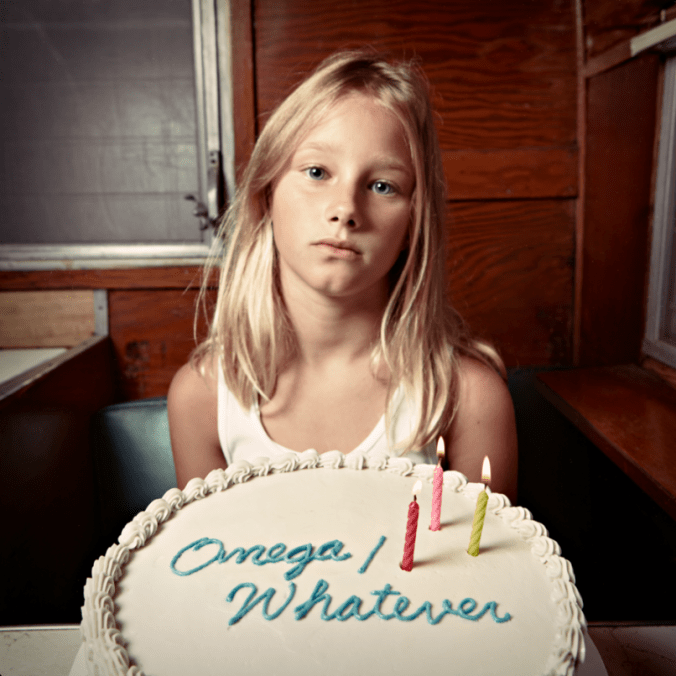
EggHunt, man. They could easily be sitting back and basking in the brilliance of their recent successes, but it’s full steam ahead with another preorder-worthy release, Omega/Whatever. Out July 29. Love the cover art.
I got to see Avers last Thursday night at the Broadberry as part of a three-band celebration of Virginia Tourism’s new “Virginia is for Music Lovers” campaign (which you should definitely check out — Andrew Cothern is doing really inspiring things in his new role there). No BS! Brass Band was first, Galax-based singer-songwriter Dori Freeman followed (you can read more about her set over at Doug Nunnally’s blog), and Avers closed the show.
I’ve gotten to see Avers a number of times, and have favorite tracks from both their Empty Light LP and their Wasted Tracks EP, but a song I wasn’t familiar with grabbed my attention. “These are the days when everything hurts” it said. “I feel ya,” my internal monologue responded. Turns out it’s one of the tracks on Omega/Whatever, “Everything Hz,” and Consequence of Sound just wrote it up. Very cool.
Avers is packed with capable songwriters, and I’m not sure who penned this one, but the title reminds me of the way The Trillions (another Charlie Glenn outfit) name songs — references to technology, with lyrics that often convey an uneasy feeling about internet culture and digital-age relationships. According to EggHunt’s site, Omega/Whatever traffics in similar concerns: “It’s an album about balance, too, centered around the struggles of living in the modern world.”
Sounds like this is going to hit extremely close to home. Balance is something I’ve been struggling with lately, and I’m really looking forward to hearing what Avers have to say on the subject. “Everything Hz” is certainly a strong, relatable start.
Step 2: Finish the interview and sit at the bar next to trumpet player Bob Miller.
Step 3: Chat with Miller about being part of the horn section that Matthew E. White and the Mountain Goats shared when they toured in support of their respective 2012 albums.
Step 4: Head to Steady Sounds the next day over lunch to snag an original pressing (!) of D’Angelo’s Voodoo.
Step 5: Take a quick look through the bins and find a used copy the aforementioned 2012 Mountain Goats album, Transcendental Youth, and pull out the liner notes to see if Bob Miller played on the album.
Step 6: See that he did and feel that “Everything is connected and beautiful” feeling.
Step 7: Play the album later that night and soak in White’s smart and reverential arrangements.
Step 8: Listen as a hair gets stuck on the needle, causing the lyrics “I could do this all day” from “Counterfeit Florida Plates” to loop perfectly about a dozen times.
Step 9: Feel that “Everything is connected and beautiful” feeling again.
Asthmatic Kitty threw this sampler in with a record I had delivered, and I grabbed it this morning not knowing that Pitchfork had posted a review of Helado Negro’s Island Universe Story: Selected Works this morning. Neat coincidence.
I really enjoy Helado Negro and am very interested in hearing Island Universe Story so I can get a more complete picture of his music and how it’s changed over time. I’m most familiar with Double Youth, which is the album the song on this sampler comes from (the Pitchfork review actually mentions it — “Invisible Heartbeat”), and while I’ve seen him perform, I only caught a few minutes — at Gallery5 during 2013’s Fall Line Fest. But those few delightfully weird minutes left a strong and positive impression. I remember thinking how cool it was that just a little time in the same room with a band or artist can be enough to form a lasting connection. It’s also reassuring. That was before my daughter was born, but I often think back on that night when it looks like I’m going to be late to a show or have to leave in the middle so I can wake up early the next day.
Here’s “Invisible Heartbeat” — I’ll check in about the rest of the sampler on Friday!
Happy Friday Cheers, y’all! A few News and Notes items to celebrate the start of my favorite 1/6 of the year:
An article I wrote about Friday Cheers and Lucy Dacus for River City Magazine just hit the interweb yesterday. Stephen Lecky and Lucy Dacus are such tremendous people and tremendous contributors to this musical community (who happen to have the same birthday, which happened to happen this week), and getting to meet and interview them meant fulfilling two huge #rvamusic bucket list items. I hope you’ll click here to check the article out or grab a print copy, which has a really snazzy “Cheers to Cheers” cover. Speaking of Friday Cheers…
The season kicks off tonight with The Soul Rebels and Mighty Joshua & the Zion #5. Wanna hear something crazy? Mighty Joshua has that same birthday! As Stephen Lecky pointed out on Twitter, this calls for a party on Brown’s Island. How does tonight sound? It may be a little wet, but some of my absolute favorite Friday Cheers experiences have been in the rain. Charles Bradley, the Funky Meters… I’m sure this week will follow suit.
Lots of great new music this week. Radiohead’s newsongs are instant classics, James Blake has a new album out today (I’ve yet to hear it the whole thing, but what I’ve heard I love), and I’m really digging this new Red Hot Chili Peppers song.
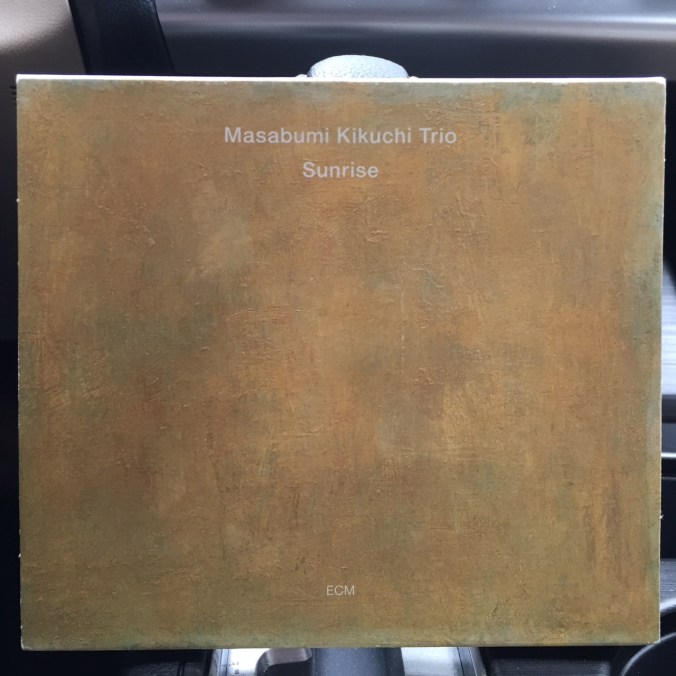
CD Monday update: What a wild ride. Sunrise can feel disconnected, and my lasting impression of it will be as a collection of individual moments, but one endearing constant glued the whole thing together for me: Masabumi Kikuchi scratchily singing along with his piano parts. His voice borders on a growl, and while it’s quiet, it’s almost always there, so it’s something of a reassurance amid the chaos. NPR described his voice this way: “His hazy voice is like a walkie-talkie transmission from the moon. It’s too weird to dislike.” Well put.
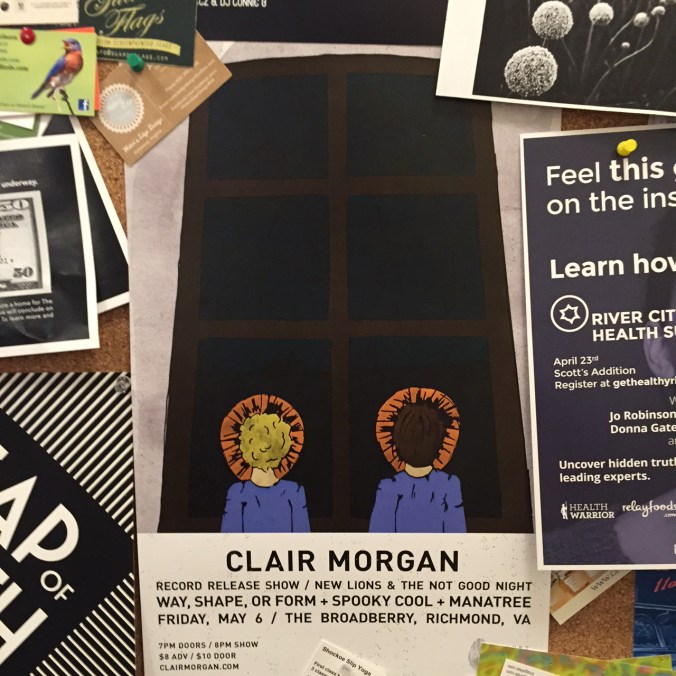
The Broadberry is the place to be this weekend. Clair Morgan’s release party tonight, People’s Blues of Richmond’s release party Saturday night. If you find a good enough overnight hiding place, you might not have to leave all weekend! Speaking of show recommendations, I highly recommend following along with Drew Necci’s RVA Must-See Shows. Great advice from one of Richmond’s most thoughtful and knowledgeable music journalists (she’s also one of the contributors to Off Your Radar).
Have a great weekend, y’all. Don’t forget Mother’s Day!
I took this picture on Record Store Day at Sugar & Twine in Carytown. Seeing these posters around town has made me so happy, because this album that’s bringing me a great deal of joy is poised to do the same for so many other people.
There are a lot of good albums out there, but music that can make you feel pure joy is rare. There has to be something about it that worms way down, through the topsoil of everyday stuff — Is this recycling week? Do I need to go to the grocery store on the way home? — to the core of what makes us who we are. The permanent stuff. The stuff that was forged years ago via childhood experiences we may have only snapshot memories of.
New Lions & the Not-Good Night (streaming now over at Pure Volume) gets to that place. It’s filled with the wonderment that’s harder to feel the older you get, starting with the album’s narrative concept and cover art, both of which were based on Clair Morgan’s two sons. There are lions and fawns and falcons and masks — things that make me want to close my eyes and imagine an animated world where all of this is unfolding. And, as is the case with the animation I find most affecting, there’s a strong undercurrent of darkness to all of it. Tim Skirven’s stunning cover art isn’t all primary colors — the visual universe he created is somewhat ominous, and a quick glance at the track list lets you know that beds are going to catch fire at some point.
And there are lyrics on this album that just knock me over. I can’t help but nod my head when I hear “Don’t understand how we could be depleted” in “Rogue Island,” given the more than somewhat significant energy disparity between my almost-two-year-old daughter and her more than somewhat occasionally sleepy parents. Speaking of foggy consciousness, “The Sea” pulls you into this great middle ground between waking and sleep, but shakes you awake with a line I can’t stop thinking about: “If your perception is wrong, then let it be.” When I interviewed the band for River City Magazine, I loved hearing Morgan talk about this aspect of the album — the idea that how you experience things as a child is vastly different from your experiences as a parent:
“When you think about an adventure you took as a child,” Morgan said, “when you’re looking through that lens, that really happened. But now you’re looking through a completely different lens, whether you’re an adult or a father, and you look back at that scenario from a completely different perspective. What did you not soak in that actually happened that you were not able to absorb?”
But here’s what’s so remarkable: Even without the cover art and the lyrical arc — if I’d heard “Rogue Island” for the first time on the radio without any context — I think I’d still get to that place of wonderment because Morgan puts so much of that feeling into the music he makes. His last album, No Notes, pointed in this same direction, with these beautiful and complicated guitar patterns that few guitarists could execute once, much less in rapid repetition while singing. It’s positively hypnotizing live — I watch, quickly become overwhelmed, and after moving past the thought of “How the hell is he doing that?” I get to a really peaceful, amazed place. Like a kid who’s purely soaking in information because processing it might mean missing something.
Clair Morgan shows are such rich experiences, and it’s not just because of the guitar work. Morgan has surrounded himself with the perfect set of collaborators — the combination of diverse instrumentation and tight precision means that they can go so much further than most bands in exploring ideas and filling them with color and shape. With New Lions, Morgan’s has truly become a shared vision, and the people who have joined him on this journey seamlessly access and add to the adventurous sensibility that made his music exceptional in the first place. The vibes’ countermelody in ‘The Sea.” The great climbing bass lines and backing vocals in “New Company.” The interplay of the guitars in “Amelia Graveheart.” Together, Clair Morgan the band operates as a machine that can convert dreams to reality, whether they’re voicing tricky harmonies, shifting time signatures or engaging in vivid storytelling. When they start playing, it really feels like anything is possible.
Take a look below at Good Day RVA’s excellent “How To Set Your Bed On Fire” video to get a sense of how the group works as a whole. It’s really inspiring, I think, in the same way that New Lions & the Not-Good Night is. To get an even better sense, head to the Broadberry on Friday for the New Lions release party. The lineup is stacked — Manatree, Spooky Cool, Way, Shape, or Form — and you can get your hands on your own copy of the album, which promises to be a 2016 bright spot, both here in Richmond and elsewhere.
My mom sent me this a few years back (I’d guess she heard this NPR story) and my daughter grabbed it on the way out this morning. The outer sleeve made it hard to pull out of the tower, but she was resolute.
So often, when I think of free jazz, I think of chaos. Screeching saxes and dissonance. The feeling of being overwhelmed. (Side note: I read this article about Albert Ayler over the weekend and would recommend it.) By contrast, Sunrise is slight and delicate, like you could break it if you looked at it wrong. Yet these performances are built on the sturdy connection between drummer Paul Motian and pianist Masabumi Kikuchi — two jazz outsiders nearing the ends of their lives. Given how sparse these tracks are, and how close to the end these two men were, tones and sounds carry so much more weight than they would in other settings. When I’m listening to more upbeat jazz, single tones can seem cheap, because the big, impressionistic picture is really what matters. Here, every note is impressionistic. The whole is almost irrelevant.
Funny story — my daughter just started trying to sing actual songs (“Twinkle Twinkle Little Star” is taking shape nicely), but for a while, I’ve been repeating random tones she blurts out to see if she’ll respond with the same note and how long we can go back and forth when she does. She gets a kick out of it and I like to think I’m planting musical instinct seeds here and there. That’s just what we ended up doing on this morning’s drive to daycare, and I bet Kikuchi and Motian would have approved.







 You Hear That
