I posted a little while back about Feral Conservatives’ gorgeous track on the Friends for Equality compilation, which benefited the Southern Poverty Law Center, the ACLU and Planned Parenthood. I wanted to give the cause another quick signal boost, as a Friends for Equality benefit show is being held tonight at Strange Matter.
You’ll find a number of details on the flyer above (music starts at 8, $5-20 suggested donation), as well as the lineup, which includes those very same Feral Conservatives. This time, funds are being raised for Forward Together (“Our mission is to ensure that women, youth and families have the power and resources they need to reach their full potential.”) and SisterSong (“Sistersong’s mission is to strengthen and amplify the collective voices of indigenous women and women of color to achieve reproductive justice by eradicating reproductive oppression and securing human rights.”).
Doors are at 7, but you can start prepping now by clicking play on the 15-minute journey RAIC calls “Penance.”
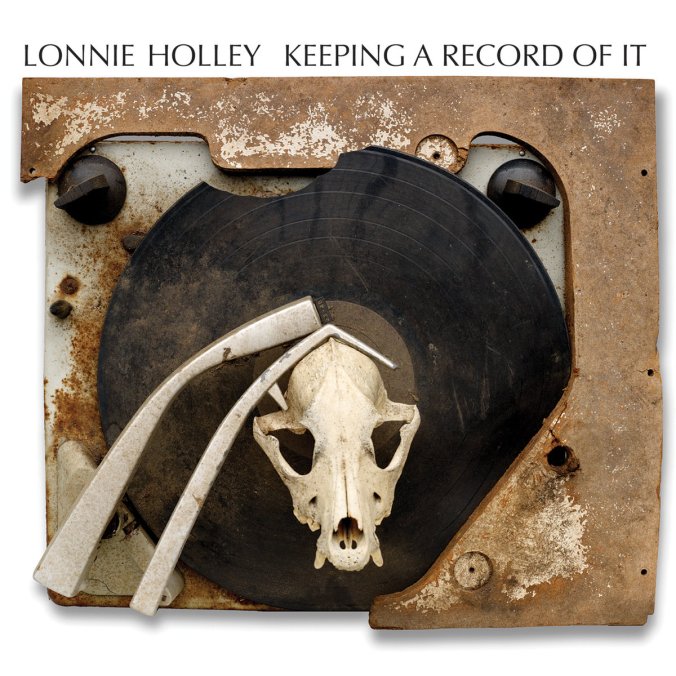
The opening set will be played by Lonnie Holley, who is an artist in more than one sense of the word. Holley first gained recognition for turning reclaimed junkyard objects into arrayed sculptures on a massive scale, which he started to do when he was 29. More than 30 years later, he’s still in constant creative motion, and from the sound of the New York Times profile White tweeted out, creation isn’t just an impulse for Holley — it’s more elemental than that. Here’s a bit I found fascinating:
We were sitting at an outdoor table with a partly filled ashtray. Holley stopped talking to reach over and pluck out a cigarette butt, examining it as if he had discovered a rare penny in a handful of change. He asked me for a sheet of paper from my notebook, then tore apart the butt and affixed its cottony filter to a wooden coffee stirrer, also liberated from the ashtray. “This is called white oak,” he said. “It’s what they use to weave baskets and things, because it’s flexible.” He fashioned a miniature paintbrush and then painted a heart and the word LOVE using ashes mixed with a few drops of his iced coffee, the solution creating an appealing speckled-eggshell patina.
It wasn’t until later, but Holley started recording music in which looped elements backline winding and soaring image-based vocal storytelling. That same New York Times piece described how all of Holley’s musical performances are unique pieces — how he makes something new each time he addresses an audience. As a person who tries to write songs and feels lucky for whatever fleeting moments of inspiration I can hold onto, I’m in awe of the total paradigm shift Holley embodies. He doesn’t so much grasp at inspiration as he floats in it. Surrounds himself in it.
I can’t want to see what he has in store tonight. In his tweet, White called it a “rare event,” which I love, given the irony at work here: Everything Holley does is once-in-a-lifetime.
Over the weekend, I stopped by Deep Groove (well, the alley next to Deep Groove) to catch a performance by Julien Baker.
I stayed near the back so I could make sure the bike I was too lazy to lock up didn’t roll away, and I’m so happy I stood there. We did miss out on quieter moments, but Baker’s voice emerged clear and resonant and triumphant again and again, and it turned into this incredibly inspiring group experiment in active listening. During songs, people were silent. Cars drove by and the wind picked up here and there, but none of the humans assembled to see Baker made a sound while she sang. It was inspiring.
The quieter moments helped me soak in what I was seeing, from the gentle slope of the alley to the way Baker’s expressions grew more pronounced the further into songs she got. It was like a cycle — the song would build, the lyrics would overwhelm, and those of us in the back would hear the climactic words loud and clear. It’s amazing how smooth and consistent those loudest notes were. Even though they delivered the most emotional words, her singing was as steady as it could have been. That alchemy that turns turmoil into strength via music — she’s got it down.
One word I was surprised to hear emerge in one of those climactic moments was badlands, as in Bruce Springsteen’s “Badlands.” I was standing next to Deep Groove’s Jay Leavitt, and I think we recognized the song at the same moment. It was awesome. Here’s a video of Baker doing the song backstage at this year’s Newport Folk Fest.
I was lucky enough to see Gillian Welch at Maymont on Sunday night. The show was excellent, aside from cicadas trying so hard to drown out the music that Welch and Dave Rawlings actually commented on them. Seeing her sing “Hard Times” was incredibly meaningful, but what’s stuck with me most is a cover they played.
“Stuck with me” might not be strong enough language. It’s more like I’ve been haunted. It’s been stuck in my head, I’ve been singing the chorus to my daughter, I’ve missed out on some sleep because my brain has decided that bedtime is when I should try to run through the lyrics… It’s a little nuts.
I’m talking about “Dublin Blues,” a Guy Clark song. Welch played it as a tribute to Clark, who died in May of this year, finishing with “We love you, Guy!” and a story about Clark championing her music early in her career. I took a video of it (I try to keep my phone in my pocket as much as possible at shows these days, but hearing “This is a cover of…” causes involuntary reflexes to kick in) and I watched a few times when I got home, then found Clark’s studio version, and haven’t really stopped listening since, if you count the intra-cranial plays.
It’s hard to put a finger on why “Dublin Blues” managed hijack my brain, but if I had to guess, I’d say it has something to do with the way it plays with the idea of sophistication. By singing “I have been to Forth Worth, and I have been to Spain,” Clark upends the notion that people who drink Mad Dog margaritas have no culture, while simultaneously elevating the everyday experiences of those who may not have the means to visit Europe. He does the same by finishing a list of wonders he’s seen — Michelangelo’s David, the Mona Lisa — with seeing Doc Watson play “Columbus Stockade Blues,” a wonder that, ironically, will never be seen again. (For a sillier take on the same idea, try “We’re Not The Jet Set.”) And the whole story is couched in heartache — something that can strike anyone at anytime. All that nuance, just three chords, as best as I can tell.
Speaking of just three chords, hey band guys — if you’re reading this, wanna cover it? I’ve been working on the lyrics…
Being there. It’s paradoxically simple and incredibly difficult. It’s also a great Wilco album, but that’s beside the point.
I struggle with balancing work and fun and music and running and writing and sleep in a way that ensures that I’m present enough. Home. Awake. Attentive. Resisting “the urge to live inside my telephone,” as Jason Isbell put it. Shit is hard.
I think that’s why seeing Doors Wide Open cover “Get Here” during last week’s Shockoe Session was so affecting. At first glance, it may seem like the lyrics beat the premise into the ground. Here’s just a sampling of the ways Brenda Russell wrote that her significant other can reach her:
Railway
Sailboat
Rope swing
Sled
Horse
Windsurfing
Magic carpet
Balloon
And that list isn’t even comprehensive. The repetition is silly, on a certain level, but it also reflects the paradox at work here. The increasingly absurd modes of transportation mirror how some of the most elaborate obstacles that stand between us and the people we care about are self-imposed. Maybe a more glass-half-full way of looking at things would be that, regardless of where you go, there’s always a way back. Or as Bill Callahan put it, “No matter how far wrong you’ve gone, you can always turn around.”
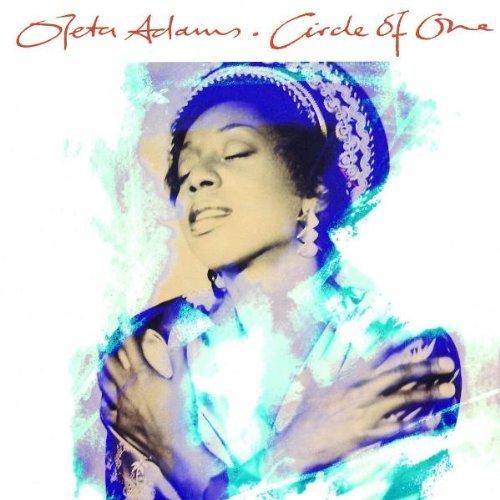
The irony here is that I had to spend time away from home to have this experience. But I really enjoyed seeing Doors Wide Open, and I hope to be invited to more Shockoe Sessions. (In Your Ear does a great job — good food, good drinks, good music, good people.) To help ensure it was time well spent, I’m putting Oleta Adams’ version of “Get Here” on my Rx playlist — songs with curative powers — alongside “Three Little Birds” and “dlp 1.1” of William Basinski’s Disintegration Loops.
Very special edition of Friday News and Notes: It’s time for Commonwealth of Notions Presents! WRIR and venerated DJ/writer/bassist/Off Your Radar contributor Shannon Cleary are teaming up for a sixth iteration of the always-entertaining and brilliantly booked local music showcase/station fundraiser. 13 bands. Two nights. Two venues. Tonight at Gallery5, tomorrow at Strange Matter. It’s the perfect way to simultaneously support and explore Richmond’s music scene.
In that same spirit, here’s an almost-exhaustive bulleted Bandcamp sampler of what’s about to go down:
Apologies to K.A. PEDERS, who has music on MySpace but my laptop won’t play it for some reason, and I’m not sure I could embed it regardless. All the more reason to head to Strange Matter on Saturday night!
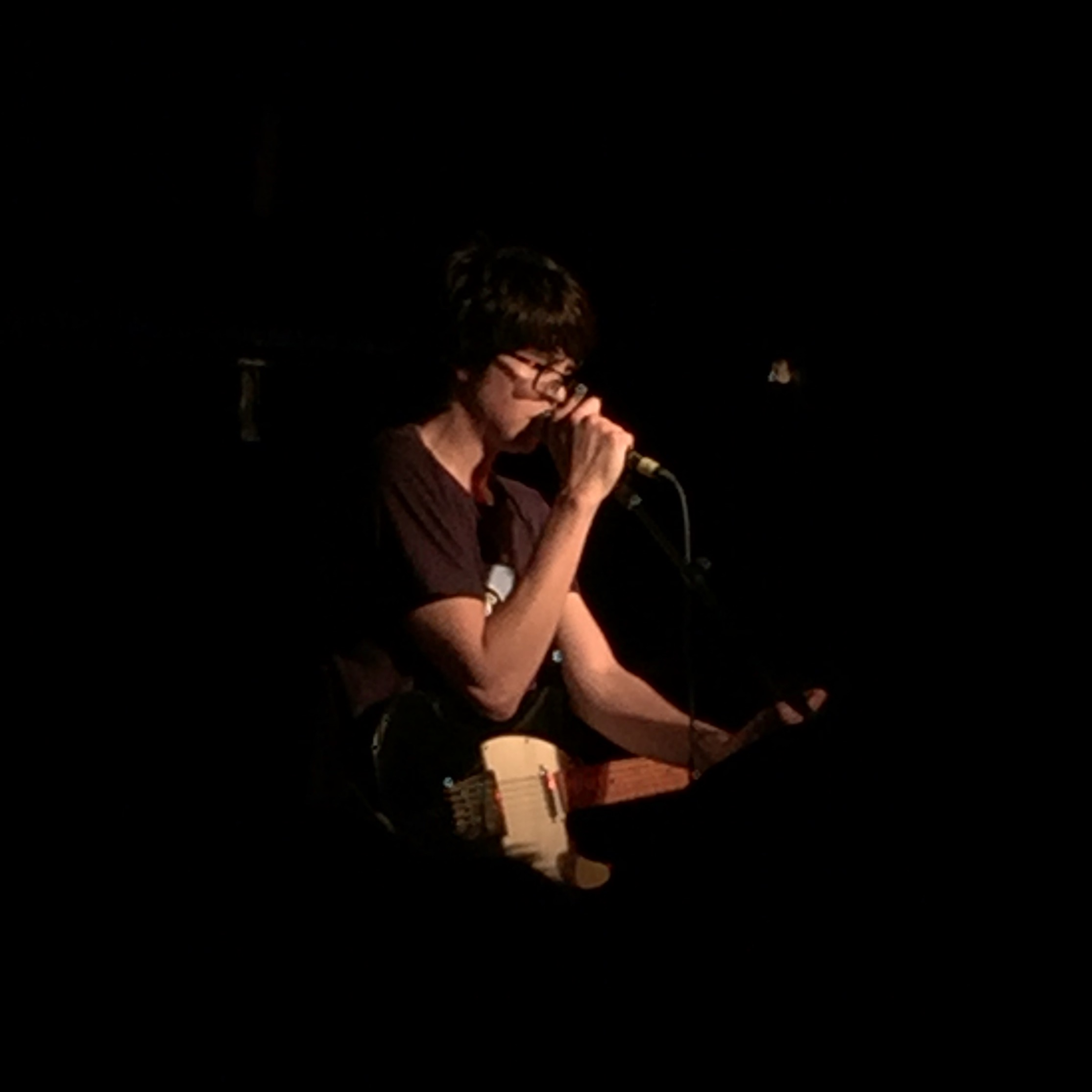
That’s one of several crappy iPhone photos I took at the Car Seat Headrest show in D.C. last week.
It’s a borderline miracle that I was there. Deciding to go was a last minute thing — I saw they were playing at the Black Cat that morning, and I’d only been listening to his/their stuff for maybe 48 hours. Plus I’d sworn off weeknight shows in D.C. and Charlottesville. I can’t tell you how many times I’ve told people (with a not-entirely-subconscious “Look how adult I am” tone) that I just can’t make those trips anymore. It’s too hard. I get so tired the next day, and my completist instincts make me want to swear things off entirely to protect myself from the pain of missing out on individual parts of that thing, if that makes any sense.
And here’s the kicker: I was getting sick. I sorta-kinda knew it at the time but was playing the denial game, and I ended up with a fever the next night. But Mrs. YHT was hosting book club that night, so I was going to be out of the house either way, and I just… I had to do it.
Going under masochistic circumstances turned out to be fitting. A few days after the show, I read an interview with Pitchfork that Will Toledo did and saw an applicable quote:
For a long time, concerts were not really my bag, because I thought it was a needlessly painful experience—between the noise of the music and having to just stand there for hours, there wasn’t a lot of enjoyment for me. But I saw Swans a year ago in Seattle, and it really blew me away. I had heard a lot of cautionary bullshit about how loud they are and how it’s the most damaging concert you’ll ever see, so I was a little concerned. But for some reason, the fact that Swans were supposed to be kind of painful actually made it more enjoyable for me.
And man was CSH loud. My friend Coyle and I were standing just a dozen or so feet away from the stage right speakers — a few rows of people behind Bob Boilen, incidentally — and I felt that rush of “Is this safe? Am I in danger?” that instinctively accompanies sensory extremes. It’s been ages since I felt that at a show. (Thanks to my pasty skin, I feel that way every time I go to the beach, but that’s a different conversation.)
But volume wasn’t the whole story. Far from it. The band was excellent, in part because “loud” is only one of the gears they can choose. There were so many changes of pace — quick left turns where distortion abruptly gave way to quiet (and the other way around), nimble lead guitar that was clear as day in spots and blissfully muddy in others, a generous emotional range, from funny to sardonic to downright angry… Toledo is a gifted, restless writer, and the group he’s put together definitely takes advantage of that.
That said, there is a constant, and it’s Toledo. His voice, especially. He conveys a deadpan manner both between songs and during them, and that matter-of-fact tone makes the language in his lyrics absolutely dance in relief. I won’t be the first or last to make this comparison, but the way Toledo emphasizes certain words via long, extended vibrato-less notes reminded me of Bob Dylan, and I ended up thinking a lot about Dylan during the band’s set. Kurt Cobain, too (probably because of the quiet-loud transitions, which Nirvana did so well). Looking back, I’m struck by how Toledo’s words and delivery represent both achievement and promise: The present seems even more impressive because of how bright the future looks for him.
Saying so might make me sound older than I am, but the truth is that I was thinking about my age almost constantly at the show. It wasn’t the crowd — there was a healthy age distribution — it was everything else. It was the fact that I knew I was getting sick but was pretending I wasn’t. It was the fact that I’d told so many people that I don’t go to D.C. shows on weeknights anymore… yet there I was. And I was there listening to guitars that were louder than I’d heard in a long time.
I think a lot about a study I saw (can’t find it at the moment) that showed how people’s taste in music calcifies between 30 and 40. I tend not to worry about that, because I love learning about new bands almost as much as I love listening to the music I already know I love — and I’m fine knowing that the brilliant new musicians I’ll be learning about in the future will, for the most part, be younger than me — but it’s weird to think that the people at the shows I go to will keep getting younger by comparison. Even though the difference wasn’t especially pronounced at the Black Cat, that idea really started to sink in, and I can’t figure out whether that bothers me or not. I’d like to think it won’t, but I’m not sure. Hopefully asking and answering the question now will help in the long run.
A few days after the show, I saw that Car Seat Headrest will be playing in Richmond in September. I’m glad I didn’t know that at the time, because I’m really glad I went to this one. It didn’t make me feel spontaneous, like I thought it might. I guess I ended up feeling like myself, which isn’t a thing that should be taken for granted. In fact, I’d go a step further and say that’s one of art’s highest callings — helping people inch closer to who they really are.
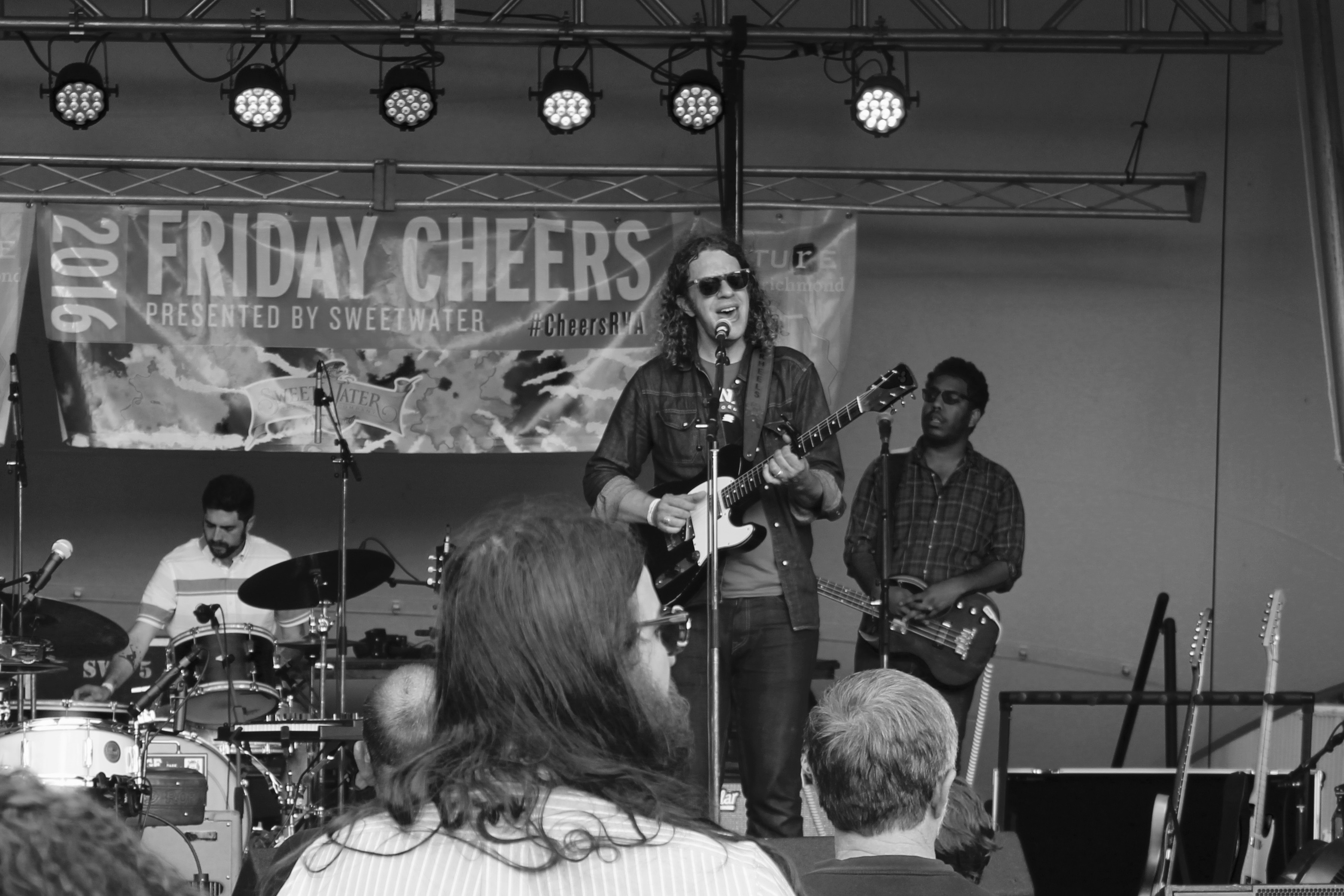
It’s hard to overstate the influence the people in this photo have had on my musical life.
Not long after Phil Cook started playing at last week’s Friday Cheers, I saw Matthew E. White walk through the crowd and settle in near the front, and at the risk of being a little bit of a creeper, I made sure to get a shot of these two hugely important people in one place.
This was my first time seeing Phil Cook play under his own name, but I’ve gotten to see him perform three (I think) times before — twice with Hiss Golden Messenger in Richmond and once with Megafaun in Portland, OR. That 2011 Portland show at the Doug Fir was the seed of something that’s grown much bigger. I’ve written about this idea before, but every single thing the Megafaun diaspora touches or is associated with — HGM, Sylvan Esso, The Shouting Matches, Grandma Sparrow — turns to gold, and those projects and Phil Cook’s solo album have brought me a great deal of happiness in the years since Portland.
Less than a year after that show, the first songs from White’s Big Inner debut (Phil Cook was involved with that too) started appearing on the interweb. I hadn’t been clued into Fight the Big Bull back then, so these songs were my introduction to White. It was a little like when I first heard White Laces — it felt like I’d stepped on a live power line in my own backyard, like “Holy crap! Was this here all along?” I preordered the album and followed White on all possible social media channels, including his Spotify profile.
I’m not sure how many of y’all use the feature that allows you to see what your friends/the people you follow are listening to, but White’s feed changed everything for me. It’s how I found out about Randy Newman. About Harry Nilsson. About Stevie Wonder. And then Stevie opened up the whole world of soul music for me — Otis Redding, Marvin Gaye, James Brown, Nina Simone… there’s an entire section of my record collection that probably wouldn’t be there if it weren’t for White’s Spotify feed.
The same goes for one of the happiest moments of my life: In the spring of 2014, Mrs. YHT and I did a long weekend in Corolla, NC while she was very pregnant, knowing we were going to skip my family’s summer beach trip that year. On the last day, before heading back to Richmond — and back to reality, where parenthood was imminent — we spent a few minutes in (what I believe is called) Historic Corolla Park literally sitting on the dock of the bay (OK, the Currituck Sound) listening to Otis Redding. For that short time, I felt completely at peace with the world and my place in it. Peace was scarce in those days, given how anxious I was before our daughter was born, so I’ll never forget listening to that song in that setting in that moment. Without Otis Redding, and by extension, Matt White, I’m not sure I would have found that sense of peace.
Toward the end of his Cheers set, Phil Cook dedicated a song to a friend in the audience, and while I can’t remember the exact words of his dedication, it seemed clear he was talking about White. The song ended up being Randy Newman’s “Sail Away.” Two days later, at the P.S. 321 Flea Market in Brooklyn, I found a copy of Newman’s album of the same name. It felt like all the musical connections I’d been thinking about for those two days came together in that one record I was holding. I’d held a copy of the album before — while flipping through records at Deep Groove a while ago — but on Sunday, it felt like the most valuable record in the entire world.
I really wish I had video of Cook doing “Sail Away” on Friday. My phone’s battery was low because I had already taped Cook playing “Crow Black Chicken,” which Ry Cooder recorded for Boomer’s Story. Here’s that recording — it’s a little blurry, but there’s an excellent bass solo from Michael Libramento. And it seems only fitting, given that this is a story about connections, to share that Ry Cooder played on Newman’s Sail Away album.
EggHunt, man. They could easily be sitting back and basking in the brilliance of their recent successes, but it’s full steam ahead with another preorder-worthy release, Omega/Whatever. Out July 29. Love the cover art.
I got to see Avers last Thursday night at the Broadberry as part of a three-band celebration of Virginia Tourism’s new “Virginia is for Music Lovers” campaign (which you should definitely check out — Andrew Cothern is doing really inspiring things in his new role there). No BS! Brass Band was first, Galax-based singer-songwriter Dori Freeman followed (you can read more about her set over at Doug Nunnally’s blog), and Avers closed the show.
I’ve gotten to see Avers a number of times, and have favorite tracks from both their Empty Light LP and their Wasted Tracks EP, but a song I wasn’t familiar with grabbed my attention. “These are the days when everything hurts” it said. “I feel ya,” my internal monologue responded. Turns out it’s one of the tracks on Omega/Whatever, “Everything Hz,” and Consequence of Sound just wrote it up. Very cool.
Avers is packed with capable songwriters, and I’m not sure who penned this one, but the title reminds me of the way The Trillions (another Charlie Glenn outfit) name songs — references to technology, with lyrics that often convey an uneasy feeling about internet culture and digital-age relationships. According to EggHunt’s site, Omega/Whatever traffics in similar concerns: “It’s an album about balance, too, centered around the struggles of living in the modern world.”
Sounds like this is going to hit extremely close to home. Balance is something I’ve been struggling with lately, and I’m really looking forward to hearing what Avers have to say on the subject. “Everything Hz” is certainly a strong, relatable start.
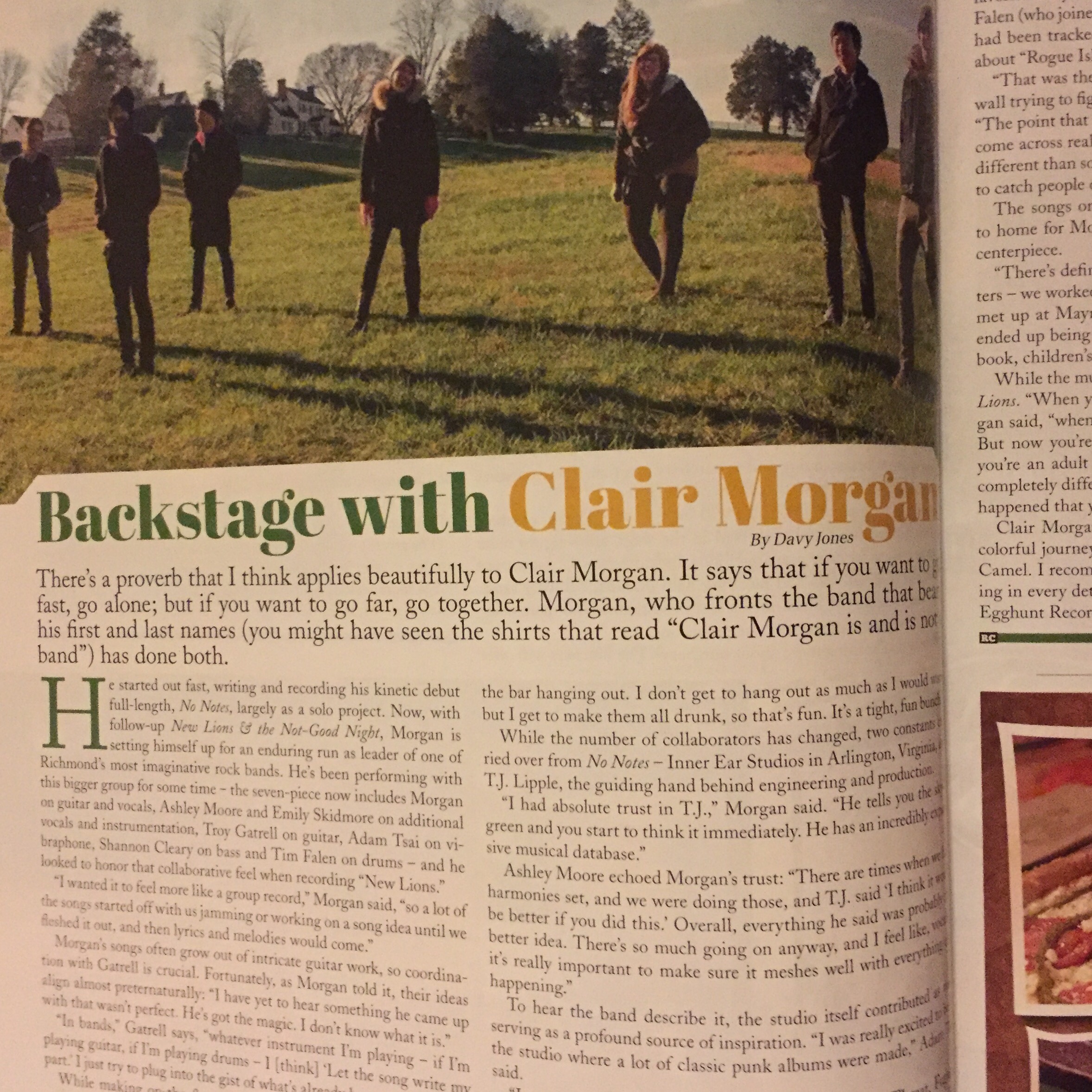
I mentioned this on Instagram last night, but what a privilege this was to work on. These are some of the most talented and friendly musicians you will ever meet, and they took the time to chat about all sorts of fun stuff, including their upcoming album, New Lions & the Not-Good Night, which I’m 100% certain is going to blow minds and win hearts. Morgan won mine in our interview with how much forethought and emotional investment went into the album’s overarching narrative. Check out this snippet from the article:
While the music is light at times, heavier themes lend balance to “New Lions.” “When you think about an adventure you took as a child,” Morgan said, “when you’re looking through that lens, that really happened. But now you’re looking through a completely different lens, whether you’re an adult or a father, and you look back at that scenario from a completely different perspective. What did you not soak in that actually happened that you were not able to absorb?”
Mind already blown. Click here to read the rest, and don’t miss their show at the Camel tonight — they’ll be closing the book on their previous album cycle by playing No Notes in full. Here’s one of that album’s standout tracks, “Battleship Heart.”





 You Hear That
